
The PTTK Pałuki Branch in Żnin (PTTK - Polish Tourist and Sightseeing Society) brings together tourists and sightseeing enthusiasts from Pałuki. The branch was founded on 7 July 1954. We organise rallies, trips and sightseeing events and verify our sightseeing badges. We work on a voluntary basis - the branch relies on the work of its members.
Where we operate
The branch operates in six municipalities: Żnin, Gąsawa, Rogowo, Barcin, Janowiec Wielkopolski and Łabiszyn. This is no random set - together these six municipalities make up the whole of Żnin County (powiat żniński) in the Kujawsko-Pomorskie Voivodeship. The boundary of our area therefore matches the county boundary, and none of the municipalities belongs to another county.
Click a municipality on the map or in the list to see the details.
Municipalities and the county - in brief. Żnin County consists of exactly these six municipalities: five urban-rural ones (Żnin, Barcin, Łabiszyn, Janowiec Wielkopolski and Gąsawa, which regained its town rights in 2024) and one rural one (Rogowo). One in three residents of the county lives in the municipality of Żnin, and almost one in five in the town of Żnin itself. Pałuki itself, however, is larger than the county - more on that below.
Pałuki - the land we roam
Pałuki is a historical and ethnographic region on the borderland of Wielkopolska, Kujawy and Krajna. You will not find it on an administrative map - it has never been a voivodeship or a county - and yet for generations its inhabitants have called themselves “Pałuczanie”. The name appears in written sources as early as the 14th century. Żnin is regarded as the capital of the region, but the towns of Pałuki also include Kcynia, Szubin, Wągrowiec and Gołańcz, among others. The region is therefore larger than our branch’s area: it extends into neighbouring counties and into the Wielkopolskie Voivodeship.
The landscape here was shaped by a glacier. It left gentle hills, long ribbon lakes arranged in chains running from north to south, and fertile soils. The region is framed by two rivers: the Noteć in the east and the Wełna in the west. On land this good, people settled very early. The most famous proof is Biskupin - a fortified settlement more than 2700 years old, discovered in 1933 by the local teacher Walenty Szwajcer.
The Piast Trail (Szlak Piastowski) runs through Pałuki. In 1227, near Gąsawa, Leszek Biały was killed during a congress of dukes. In Wenecja stand the ruins of the castle of Mikołaj Nałęcz, known as the Devil of Wenecja (Diabeł Wenecki), and since 1894 a narrow-gauge railway with a track gauge of just 600 mm has run from Żnin through Wenecja and Biskupin to Gąsawa. Żnin is associated with the brothers Jan and Jędrzej Śniadecki, scholars of the Enlightenment - our office is on the street named after them.
Pałuki also has its own folk culture: a costume with distinctive white embroidery, a dialect and a cuisine. For the tourist it is above all a region “for a weekend and for a bike”: short distances, little traffic on the back roads, a lake every few kilometres and fifteen wooden churches, linked by our sightseeing badge.
Biskupin
An archaeological reserve with a reconstructed fortified settlement - a Monument of History (Pomnik Historii) and the best-known place in Pałuki.
Narrow-gauge railway
Żnin - Wenecja - Biskupin - Gąsawa. One of the narrowest railways in Europe, with a museum in Wenecja along the way.
Lakes and two rivers
The Żnińskie and Rogowskie lakes and dozens of smaller ones, plus the Noteć and the Wełna for kayakers.
Wooden churches
Fifteen churches on the trail of our badge - from Gąsawa to Świątkowo and Tarnowo Pałuckie.
Wenecja and Lubostroń
The ruins of the castle of the Devil of Wenecja and the neoclassical Skórzewski palace with its park.
A region for cycling
Quiet back roads and gentle terrain - a good place for the family rallies we organise every season.
What we do
Rallies and trips
Hiking and cycling rallies around Pałuki and coach trips around Poland.
Sightseeing
Sightseeing events, regional knowledge contests and quests for families.
Badges
We verify our badges: “Trail of the Wooden Churches of Pałuki” (Szlakiem Pałuckich Kościołów Drewnianych) and the Pałuki Sightseeing Badge (Pałucka Odznaka Krajoznawcza).
Cooperation
We work together with municipalities, schools and local organisations.
Join us
The branch is made up of its members. See how to become a PTTK member and what the membership card gives you.
Branch details
- Pałucki Oddział Polskiego Towarzystwa Turystyczno-Krajoznawczego w Żninie
- KRS 0000033370 · NIP 562-10-04-853 · REGON 090541384
- Registered office: ul. Śniadeckich 15, 88-400 Żnin
- A local unit of PTTK with legal personality, operating on the basis of the PTTK Statute and the branch statute
Branch governing bodies
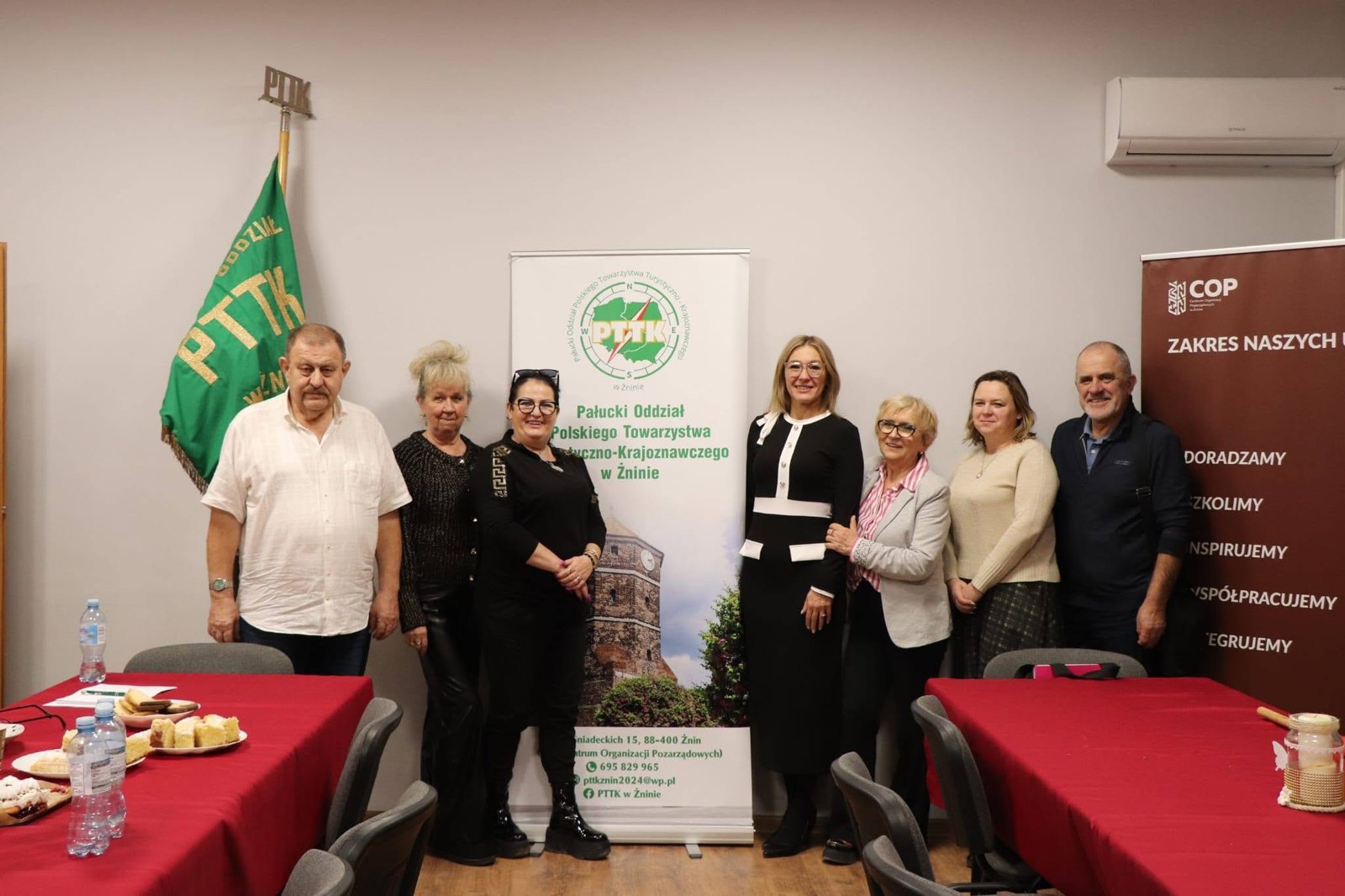
- President of the Branch Board: Magdalena Gabryszak
- Vice-President of the Board: Włodzimierz Sulecki
- Secretary: Karolina Konarska
- Treasurer: Wanda Peplińska
- Board members: Renata Igła, Ewa Kaczmarek, Jan Strzelecki
Audit Committee (Komisja Rewizyjna)
- Chairman: Ryszard Ludkiewicz
- Secretary: Iwona Bojko
- Member: Mirosław Marek
Documents
Statute of the PTTK Pałuki Branch (2026) - available for download soon. Reports and resolutions of the Branch Assembly - at the branch office.
Partners and sponsors
We thank the municipalities, companies and institutions that support our events. Would you like to become a partner of the branch? Write to us.
Data sources: population and area - GUS (Statistics Poland), Bank Danych Lokalnych (Local Data Bank), as at 31.12.2025. Municipal boundaries and base map - © OpenStreetMap contributors.